
Book and Go

India History, Language and Culture
History of India
India's history stretches back thousands of years, making it one of the world's oldest continuously inhabited civilisations. The earliest chapters begin with the Indus Valley Civilisation, known for its sophisticated urban planning, followed by the rise of powerful kingdoms and empires that shaped religion, philosophy, art and governance across the subcontinent. Hinduism, Buddhism and Jainism all emerged here, and India became a centre of learning and trade linking East and West.
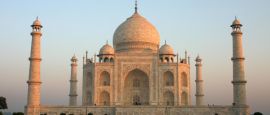
From around the 4th century BCE, large imperial states such as the Maurya Empire unified vast areas of the subcontinent, encouraging administration, infrastructure and the spread of ideas. Later centuries saw a succession of regional dynasties alongside periods of foreign influence, most notably under the Mughal Empire, whose rulers left behind some of India's most celebrated monuments, including the Taj Mahal, and helped shape a rich cultural synthesis visible in architecture, language and cuisine.
From the 18th century, European trading powers gained influence, culminating in direct colonial rule under the British Raj. This period brought railways, new administrative systems and global trade links, but also economic exploitation and widespread social upheaval. Growing resistance to colonial rule gave rise to a powerful independence movement rooted in mass participation and non-violent protest.
India gained independence in 1947 following decades of struggle led by figures such as Mahatma Gandhi, alongside many other political and social leaders. Independence was accompanied by the partition of British India, creating the modern states of India and Pakistan and resulting in large-scale displacement and upheaval.
Since independence, India has developed into the world's largest democracy, balancing ancient traditions with rapid social, economic and technological change. Its layered past remains deeply visible today, from sacred sites and historic cities to living customs and festivals, giving visitors a vivid sense of how history continues to shape everyday life.
Did you know?
• India has the world's largest postal network, with over 150,000 post offices, many of them in rural areas; the highest is located in Hikkim, Himachal Pradesh, at an altitude of more than 4,400 metres.
• The Kumbh Mela pilgrimage is the largest peaceful gathering on Earth. During peak years, tens of millions of people bathe in sacred rivers over a single festival period, visible even from space due to its sheer scale.
• India officially recognises 22 languages and uses hundreds more in daily life, making it one of the most linguistically diverse countries in the world; some Indian states are organised largely along linguistic lines.
Language in India
India is one of the most linguistically diverse countries in the world and has 22 officially recognised languages. Hindi and English are the main languages used by the central government, and English is widely spoken in cities, tourist areas, hotels, airports and within the business and hospitality sectors, making travel relatively straightforward for visitors.
Hindi is the most widely spoken language overall, particularly in northern and central India, while regional languages dominate daily life in different states. These include Bengali in West Bengal, Tamil in Tamil Nadu, Telugu in Andhra Pradesh and Telangana, Marathi in Maharashtra, Gujarati in Gujarat, Punjabi in Punjab and Malayalam in Kerala, among many others.
In tourist centres and major cities, signage is commonly bilingual in local languages and English, and many people working in tourism have a good working knowledge of English. Learning a few basic words in Hindi or the local language is appreciated, but not essential for most visitors.



 You know where
