

Jordan History, Language and Culture
History of Jordan
Jordan's history is a long story of movement, exchange, and adaptation, shaped by its position at the crossroads of ancient trade routes linking Arabia, the Levant, and the Mediterranean. From the earliest human settlements to modern statehood, the land that is now Jordan has been passed through, settled, and ruled by successive civilisations, each leaving traces that remain visible today.
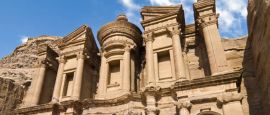
Some of the most distinctive early marks were left by the Nabataeans, an Arab people who controlled lucrative caravan routes and built their capital at Petra. Mastery of water management enabled them to thrive in an arid landscape, creating cities carved into rock and connected by desert trade routes. Their influence declined with the arrival of Roman rule, but their architectural legacy remains one of the most striking in the ancient world.
Under the Romans, the region became part of a wider imperial network. Cities such as Jerash flourished with theatres, temples, and colonnaded streets, many of which survive in remarkable condition. Later, the Byzantine period saw the spread of Christianity, reflected in churches, mosaics, and pilgrimage sites that link Jordan closely to early Christian history.
The arrival of Islam in the 7th century brought new political and cultural influences, and Jordan became part of successive Islamic caliphates. Over the centuries, the area was ruled by dynasties including the Umayyads, Ayyubids, Mamluks, and Ottomans, each contributing to the region's layered identity. Castles, desert palaces, and historic towns from these periods are scattered across the country.
Modern Jordan emerged in the 20th century following the collapse of the Ottoman Empire. The Emirate of Transjordan was established under British mandate and gained independence in 1946, becoming the Hashemite Kingdom of Jordan. Since then, Jordan has navigated regional upheavals while maintaining relative stability, a continuity that allows visitors today to explore its past not as a distant abstraction, but as a living landscape where history is part of everyday life.
Did you know?
• Jordan is home to the world's lowest point on land at the shores of the Dead Sea, which sits more than 430 metres (1,410 ft) below sea level.
• The desert of Wadi Rum contains rock carvings and inscriptions dating back over 12,000 years, left by early inhabitants and travellers long before the rise of recorded civilisations.
• Despite its arid climate, Jordan hosts important wetlands such as Azraq, which play a vital role in global bird migration routes between Africa, Europe, and Asia.
Language in Jordan
Arabic is the official language of Jordan, and Modern Standard Arabic is used in government, media, and formal settings. In everyday life, Jordanians speak Levantine Arabic, which visitors may hear in markets, taxis, and social situations. While pronunciation and expressions can vary slightly by region, Jordanian Arabic is generally clear and widely understood across the Middle East.
English is widely spoken, particularly in Amman, Aqaba, and other tourist areas. It is commonly used in hotels, restaurants, shops, and by people working in tourism, business, and government services. Road signs, menus, and official information are often bilingual, making travel relatively easy for English-speaking visitors.
Learning a few basic Arabic phrases, such as greetings or polite expressions, is appreciated and often warmly received, even if English is used for the rest of the interaction. Overall, language is rarely a barrier for visitors to Jordan, especially in places frequented by tourists.



 You know where